

Self-Guided (D.I.Y.)
GENERAL OVERVIEW
Please review the information in the Services Australia link below to see if you meet the general eligibility requirements before continuing with your claim.
Additional factsheet link also provided, summarising key information.
PROGRAM OF SUPPORT REQUIREMENTS
This factsheet explains the Program of Support (POS) requirements for the Disability Support Pension (DSP).
If you are assessed as having 20 impairment points across multiple impairment tables, you will generally need to complete 18 months of Program of Support participation before you can qualify for DSP. An exception may apply if you are unable to continue participating solely because of your medical condition.
If this may be relevant to your situation, we recommend registering with a Disability Employment Services (DES) provider and commencing a Program of Support before lodging your DSP claim.
Please read the factsheet, and provide the attached “Form for DES”, to your DES provider for further discussion. Please note that exemption periods generally do not count towards the 18-month participation requirement.
UNDERSTANDING THE TABLES
The Legislation
The Impairment Tables are used by assessors to decide if you meet the medical eligibility requirements for the Disability Support Pension (DSP).
The tables measure how your medical conditions affect your ability to function and are used to determine your impairment rating (points).
Before a condition can be assessed using the tables, it must be:
– Formally diagnosed.
– Reasonably treated.
– Permanent.
Once these requirements are met, the appropriate Impairment Table is used to determine your impairment rating.
MANIFEST ELIGIBILITY
Some medical conditions may qualify for Manifest Eligibility, allowing a DSP claim to be fast-tracked and approved without further assessment if enough medical evidence is provided.
The examples below are some of the most common situations, but they are not a complete list of all circumstances where Manifest Eligibility may apply.
Examples include:
– A terminal illness with a life expectancy of less than 2 years.
– Permanent blindness that meets the social security definition.
– An intellectual disability with an IQ below 70.
– An assessment showing you require nursing home level care.
– Category 4 HIV/AIDS.
– Receiving a Department of Veterans’ Affairs (DVA) disability pension at the Special Rate (Totally and Permanently Incapacitated – TPI).
If you think you may qualify, ensure your medical evidence clearly supports your claim.
WORK CAPACITY
A quick note about work capacity, as it is closely linked to the assessment of your functional impairment.
To be eligible for DSP, you must generally have a work capacity of less than 15 hours per week. However, assessments of work capacity can sometimes be higher than a person’s actual ability to work. In addition, if you are assessed as having some capacity for work (especially more than 8 hrs pw), it may be more difficult to achieve the required 20 impairment points, depending on which Impairment Tables apply to your conditions.
COLLECTING EVIDENCE

Medical Report Form for Doctors
In 2015, Centrelink stopped using medical report forms for DSP applications. They now rely on general medical evidence instead.
We created an easy-to-use medical form to help doctors cover what’s needed for medical eligibility. Use it alongside the relevant Tables and our other guides.
Why use this form:
- Accepted by Centrelink
- Works for both new claims and appeals
- Suits GPs and specialists
- Covers each condition and how it affects your daily function
How to use it:
- Email it to your doctor with the relevant Tables, or
- Print it to take to your appointment
- Doctors can also use it as a template for their own report
*Private clients receive a custom form tailored to their specific condition(s).
How to save the form:
1. Click the button above to open the form.
2. Right-click on the form and choose “Save as…”
3. Save it to your computer or device.
Click here for printable version

The Tables
The previously provided Tables legislation has been broken up into two sections here. The first link is a shortened version of the rules on how to use the tables to allocate points. It is a good idea to be familiar with this and to have a copy on hand for doctors just in case they require it.
The second link is where you can download the individual tables. You will need a copy of each table relevant to your conditions to provide to your doctors. Ideally highlighting the rating that you believe applies to your symptoms. Use as many tables as are relevant.

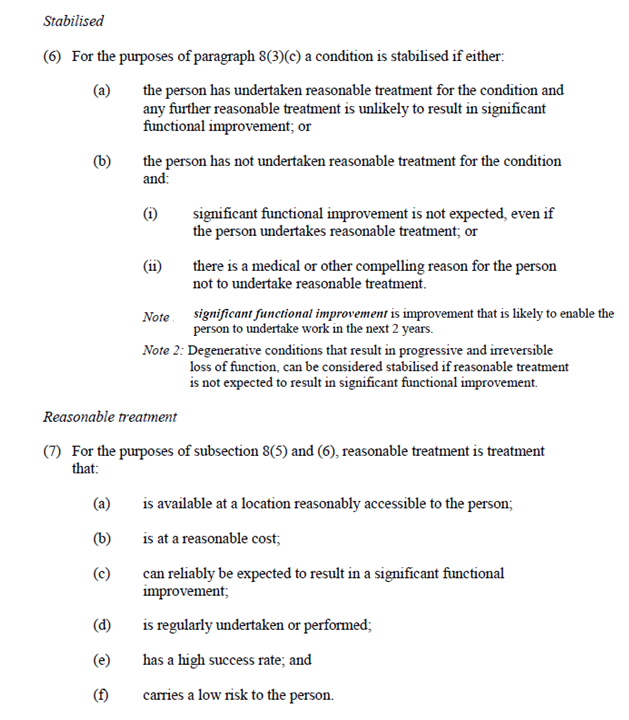
STABILISED
One of the more common reasons for rejection is that a condition is not considered “stabilised”. Stabilised has a unique definition in the legislation which varies from the typical medical definition.
An example clarifying statement for doctors:
“all reasonable potentially effective treatment options have been explored. All current treatments are for maintenance purposes only and not likely to provide any significant improvement in the near future”*
* We only encourage doctors to provide statements that are fact based.
CENTERLINK CHECKLIST
These Centrelink checklists can help claimants and treating health professionals understand the information needed for a DSP claim. They may be useful for doctors who prefer official Centrelink documents.
Please note: These checklists are not medical evidence and should not be used to support your claim. They are intended as a guide or checklist only and must be supported by detailed medical evidence.
READY TO LODGE YOUR CLAIM?
- Checked your general (non-medical) eligibilty
- Collected historical evidence
- Collected updated medical evidence (under 2 years old)
- Complete and lodge online application form via myGov

REJECTED?
Click here for Self guided (D.I.Y.) Appeals
Click here to access One-on-one guided support